 Loading... Please wait...
- Home
- GYMnTONIC Blog
- buy protein
GYMnTONIC Blog - buy protein
This is how much protein strength athletes need on their non-training days
Posted by Arash Bandegan3, Glenda Courtney-Martin4,5, Mahroukh Rafii4, Paul B Pencharz4,6,7, and Peter WR Lemon3,* on 26th Jun 2017
This is how much protein strength athletes need on their non-training days
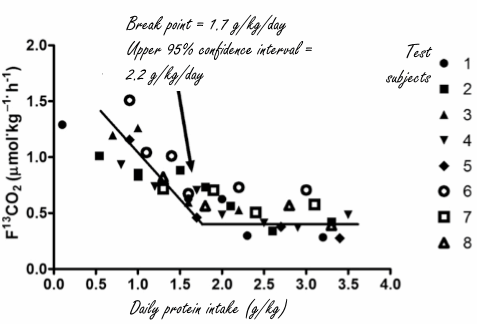
If you do strength training several days a week you'll still need about 1.7 g protein per kg bodyweight on the days you don't train. And if you want to be completely certain of getting enough protein you can jack that up to 2.2 g protein, report Canadian sports scientists in the Journal of Nutrition.
Study
The researchers gave men aged 18-40, who had been doing strength training for at least three years and worked out at least four times a week, different amounts of protein on different occasions during their non-training day. Part of the amino acid phenylalanine that the participants got was labelled so that the researchers could measure from their breath the amount of phenylalanine the men burned.
The body cannot store amino acids. It uses them to build tissue and burns the amino acids that it doesn't need. Because the body needs amino acids in a fixed ratio for building tissue it's possible to see whether an organism is consuming enough protein by looking at how much of a specific amino acid is being burned.
That's a short description of the indicator amino acid oxidation technique as it's called. [J Nutr. 2008 Feb;138(2):243-6.] The researchers used this technique for their strength athletes.
Results
The oxidation of phenylalanine was at its lowest point at a daily protein intake of 1.7 g per kg bodyweight for the average participant. The oxidation of phenylalanine did not decrease any more at a higher protein intake. That means that at a daily protein intake of 1.7 g per kg bodyweight the average participant consumed all amino acids that are necessary for tissue build up.
That's for the average participant. The protein intake was optimal for all participants when 2.2 g protein per kg bodyweight was consumed.
Conclusion
"Our indicator amino acid oxidation data are consistent with earlier nitrogen balance findings that suggest that chronic strength training increases dietary protein needs and, in addition, indicate that, at least in bodybuilders with greater-than-typical fat free mass, protein requirements measured on a non-training day exceed the current recommended dietary allowance," the researchers concluded.
"Therefore, on the basis of these data, we believe that, at least in the case of individuals who engage in bodybuilding exercise chronically, the conclusion of the Institute of Medicine that 'no additional dietary protein is suggested for healthy adults undertaking resistance or endurance exercise' needs to be reassessed."
Source:
J Nutr. 2017 May;147(5):850-7.
Check out our Entire Line of Proteins!!!! (click LINK below)
http://stores.gymntonic.com/protein-powders/
Cardio training boosts the effect of strength training on muscle growth
Cardio training boosts the effect of strength training on muscle growth [...]

Uncovering The Truth: Protein Quality Test
Uncovering The Truth: Protein Quality Test By Mark Glazier Protein Pop Quiz: Which one of these proteins is the best? A) 18g protein per serving B) 25g protein per serving C) 33g protein per servingThink it’s C? It’s actually a trick question (sorry). Every company brags on their label about how much protein is in their product. The truth is, you can’t [...]
Pea Protein: The Future of Sports Nutrition??
Pea Protein: The Future of Sports Nutrition?by Matt WeikThe plethora of protein powders on the market makes choosing a powder to try extremely different. You have fast digesting, slow digesting, complete proteins, incomplete proteins, whey concentrate, whey isolate, egg protein, casein, the list goes on and on and now you have another choice—pea protein. Wait, [...]