Loading... Please wait...
Categories
New Products
-
 $59.99
-
 $54.99
-
 $14.99
-
 $19.99
-
 $19.99
Our Newsletter
- Home
- Syringes + Medical Supplies
- SLEEP AIDS
- Stage3Z - Sleep Product


)
Product Description

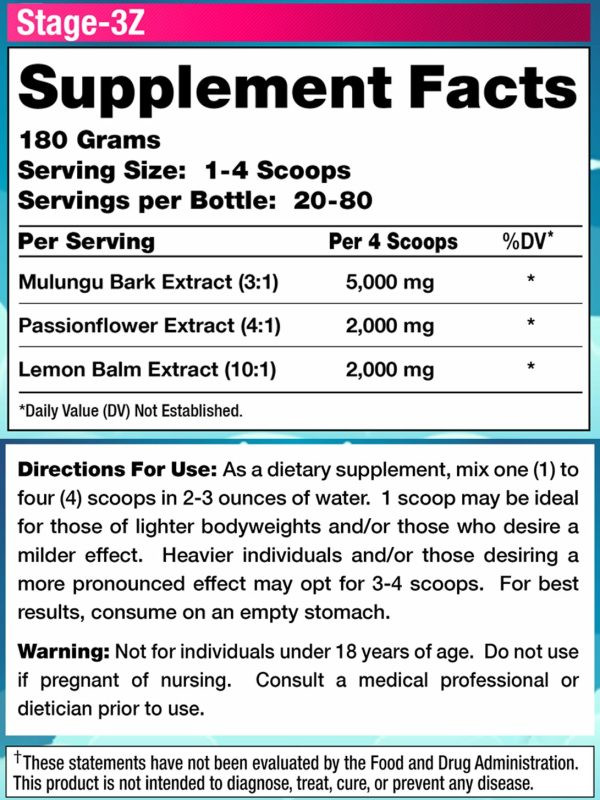
Stage-3Z
Induces Slow Wave Sleep
Slow-wave sleep (SWS), often referred to as deep sleep, consists of stage three of non-rapid eye movement sleep.[2] Initially, SWS consisted of both Stage 3, which has 20–50 percent delta wave activity, and Stage 4, which has more than 50 percent delta wave activity.[3]: 291
WHAT IS SLOW WAVE SLEEP?
Slow wave sleep is also known as deep sleep–it is the stage of sleep when your body is in its most restful state. Your brainwaves are the slowest during SWS, and when monitored with an EEG their activity is synchronized. During this time your heart rate and respiratory rate decrease significantly, and your muscles relax as well. It can be quite difficult to wake up from slow wave sleep, even if there are loud noises. If you are woken during SWS, you often feel disoriented and groggy.
After falling asleep, your body soon transitions from light sleep to slow wave sleep (then later to REM sleep). Your first period of SWS usually lasts 45-90 minutes. As the night goes on, episodes of SWS become shorter in the sleep cycles that follow. Most adults typically go through about 3-5 full sleep cycles a night.
WHAT IS THE FUNCTION OF SLOW WAVE SLEEP & WHY IS IT IMPORTANT?
Slow wave sleep is when your body physically restores itself. Roughly 95% of human growth hormone is produced during this stage of sleep. A common misconception people have is that you get stronger when you’re at the gym or while you’re exercising, but that is not the case. Working out causes your muscles to break down, then they build themselves back up again during slow wave sleep. Getting a sufficient amount of SWS is crucial in order to maximize your potential gains from that day’s training.
Additionally, each of the following processes happen during slow wave sleep:
- Blood flow to muscles increases
- Cells are regenerated
- Tissues and bone are repaired
- Immune system is strengthened
- Blood sugar levels and metabolism are balanced
- Brain is detoxified
HOW MUCH SLOW WAVE SLEEP IS NORMAL?
Most adults typically spend 15-25% of their time asleep in SWS, which translates to about an hour or two per night.

It’s worth noting that SWS tends to decrease with age, primarily due to the fact that growth and development are essential components of it. Adults spend less time in slow wave sleep than children do, and seniors get even less of it than adults.